
Artificial intelligence is no longer a technology businesses can afford to watch from the sidelines. For employers, the more pressing question is how to manage a transition that could fundamentally alter the nature of professional work, while creating new opportunities and significant economic and social challenges.
That was a central theme of discussions at the Ireland Canada Business Summit, where economists, lawyers and business leaders examined how AI is changing recruitment, decision-making, productivity and the skills required across organisations.
While speakers differed in their expectations about the scale and speed of AI’s impact, the discussions highlighted a common challenge for businesses: how to capture the technology’s potential productivity benefits while managing the risks it creates for employees, organisations and the wider economy.
Karina Doorley, Associate Research Professor at the Economic and Social Research Institute (ESRI), explained that AI differs from previous technological revolutions because it can perform cognitive rather than primarily manual tasks.
“Some jobs that exist now will be done by AI in the future,” she said.
Unlike earlier waves of automation, which predominantly affected manual workers, Doorley suggested that highly skilled employees could be particularly exposed. Emerging evidence, she said, indicates that younger, highly skilled graduates may be among those most affected.
That shift has important implications for policymakers. Doorley expects AI to cause job displacement alongside the creation of new roles and opportunities for workers to move into different employment. However, she emphasised that the speed of this transition remains unknown and will be crucial in determining its consequences.

Her research identifies three broad effects that could shape the labour market and the distribution of income. Some existing jobs will disappear or change significantly. Workers whose roles are retained or complemented by AI could become more productive and see higher wages. At the same time, returns to capital could increase as businesses invest more heavily in AI systems.
Taken together, Doorley said these developments point towards a potential increase in income inequality in the short term, although the scale of their impact remains highly uncertain. She warned that widening the gap between rich and poor could have consequences for economic growth, social cohesion and political stability.
The longer-term picture, however, may be less pessimistic.
Doorley pointed to previous technological revolutions in which automation eliminated some occupations but created new industries and professions. She suggested that a similar process could unfold with AI, particularly if workers are supported in acquiring new skills.
She also identified potential benefits for public finances, including higher tax revenues if wages increase and reduced welfare spending if large-scale job displacement is avoided. Doorley pointed to Nobel Prize-winning economist Christopher Pissarides’s prediction that AI could eventually help bring about a four-day working week, describing increased leisure time as one of the more optimistic possibilities.
For businesses, however, the immediate challenge is how to deploy the technology effectively and safely.
Jon Legorburu, partner and head of litigation and regulation at Byrne Wallace Shields and a professor at Dalhousie University, cautioned against treating today’s large language models as reliable decision-makers.
Generative AI, he argued, should be understood as a prediction-based technology rather than an intelligent system in the human sense. While he praised its ability to summarise documents and extract key information, he warned that asking AI questions could produce inaccurate answers delivered with considerable confidence.
“The more complex the model, the more it hallucinates,” he said, highlighting the continuing challenge of improving accuracy as AI systems become more capable.
Legorburu warned that these problems create significant challenges for businesses deploying AI, particularly law firms, where accuracy is essential. Based on his experience managing a law firm, he suggested that AI would change the nature of people’s jobs rather than necessarily lead to widespread redundancies.
He also highlighted another issue moving rapidly up the international agenda: digital sovereignty.
As governments and businesses become increasingly dependent on AI platforms developed overseas, questions are emerging about strategic control over critical technologies. Legorburu pointed to growing European efforts to develop domestic large language models, including France’s Mistral, alongside emerging Canadian-European collaborations intended to provide alternatives to dominant US and Chinese technology platforms.
He argued that closer cooperation between Canada and Europe on AI could create significant opportunities for Ireland. Pointing to the Comprehensive Economic and Trade Agreement (CETA), growing European interest in digital sovereignty and new international technology partnerships, he suggested that Ireland could position itself as an important gateway into Europe for AI-related business.
Corporate leaders at the summit described how these developments are already translating into practical changes within their organisations.
At Greenfield Global, managing director Ken Finegan said AI was helping the company accelerate growth and bring products to market more quickly. He highlighted improvements in technical documentation, validation and stability protocols, and manufacturing data analysis, which were helping the business respond more efficiently to customers.
“We’re reaping the benefits of it at this early stage,” he said.
However, Finegan emphasised that quality assurance and regulatory compliance remain essential, particularly given the company’s role in supplying pharmaceutical manufacturers. He explained that the business maintains extensive quality checks and validation milestones throughout its product development and commercialisation processes.
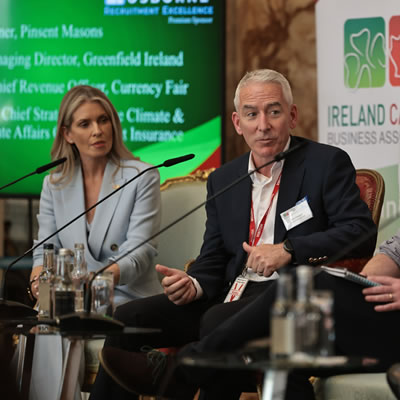
CurrencyFair’s chief revenue officer, Stephen Baker, described AI as integral to the company’s operations, from customer acquisition and marketing to identity verification, due diligence and compliance processes.
Baker estimated that AI had helped CurrencyFair quadruple its capacity in parts of the customer activation process, while suggesting that the technology’s potential benefits extended considerably further.
Asked whether AI would change people’s jobs or reduce the number of employees required, he suggested that both outcomes were possible.
He described how tasks that previously required considerable time, such as preparing weekly reports, could now be completed in minutes. But he also emphasised the growing importance of employees who can ask intelligent questions and deploy AI effectively.
For future roles in his industry, he suggested, a central question would be: “How do you deploy this stuff?”

Amanda Johnson, Chief Strategic Change and Corporate Affairs Officer at Intact Insurance, said the group had been investing in AI for a decade. She reported that it had deployed 600 AI models, supported by 600 specialists including actuaries, data scientists and engineers, delivering substantial annual savings.
However, Johnson emphasised that successful implementation required more than technology. She highlighted investment in employees, strong governance, responsible use of customer data and a focus on customer outcomes.
She described AI as “an accelerator”, while acknowledging the nervousness surrounding a technology whose capabilities and implications can be difficult to fully understand.
Johnson argued that organisations needed to be deliberate about where and how they deployed AI, ensuring employees understood the technology and that its use aligned with the organisation’s values and responsibilities to customers.

Taken together, the discussions highlighted both the opportunities and uncertainties surrounding artificial intelligence. While speakers identified significant potential for productivity gains, new capabilities and changes in how people work, questions remain about job displacement, the distribution of economic benefits and the governance required to deploy the technology responsibly.
For Ireland and Canada, the discussions also highlighted opportunities for closer cooperation in AI development and adoption, particularly as both countries seek to strengthen their economic relationship and international competitiveness.
The challenge for businesses and policymakers is not simply whether to adopt AI, but how to ensure that its benefits are realised while managing the economic and social consequences of technological change.